
Reflections, frameworks, and strategic perspectives on governance, risk, information security, and ethical leadership.
Articles, essays, and thought leadership designed to help leaders navigate uncertainty with clarity and integrity.
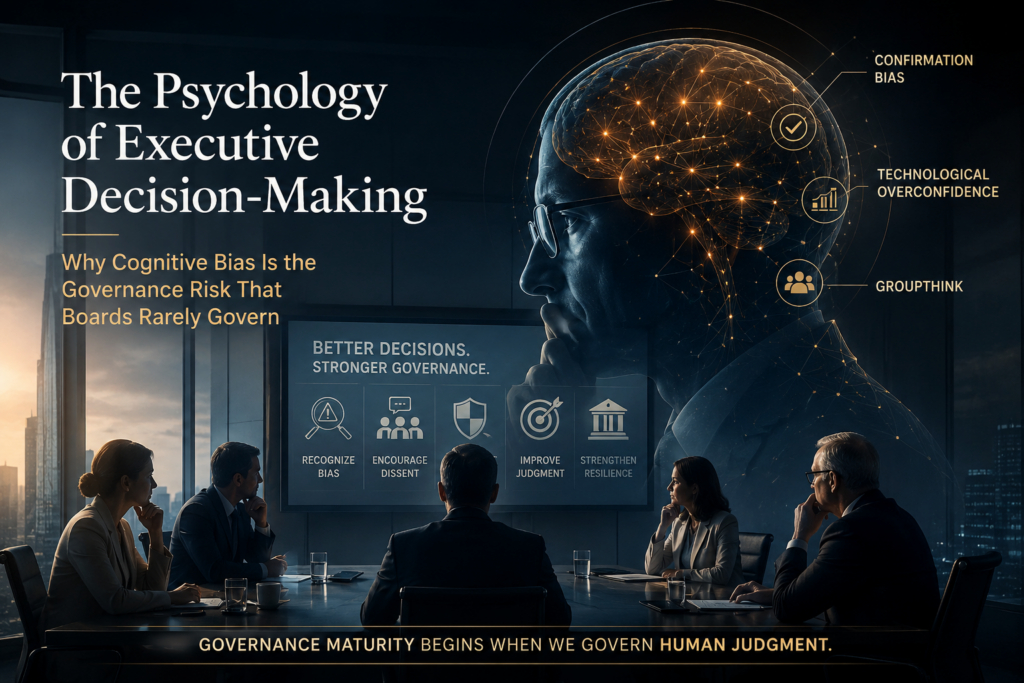
From Structural Governance to Cognitive Governance
The article introduces the idea that governance must evolve beyond managing organizational structures to managing the psychological forces that shape strategic decisions. As organizations become more data-driven and technologically sophisticated, the quality of human judgment becomes the defining governance capability.
Among these, “From Structural Governance to Cognitive Governance” best captures what makes your article distinctive. It is not simply about cognitive bias or decision-making; it proposes an evolution in governance thinking—from focusing primarily on structures, processes, and controls to recognizing human cognition as a governance variable that must itself be governed. That is the article’s original and unifying perspective.
The true quality of governance and leadership is not measured during periods of stability, but in times of crisis — when pressure reveals whether an organization’s principles, culture, and decision-making capacity are genuinely structural or merely performative.
Most strategies don’t fail at execution. They fail because the organization’s real tolerance for uncertainty never matched its declared ambition.
What Boards Get Wrong — and What It Costs
AI adoption is accelerating. Governance is not. That gap is not a technology problem — it is a leadership failure, and the exposure it creates is fiduciary, reputational, and strategic.
Security protects systems; trust protects value. Digital trust emerges when technology, governance, and ethics converge — turning protection into confidence and security into competitive advantage.
Ethical Leadership in a Digital Age:
In a hyperconnected world, the first security breach is rarely technical — it is ethical. Integrity becomes the true firewall that protects trust, decisions, and organizational resilience. Read →
From Compliance to Confidence:
Governance evolves from a regulatory obligation into a leadership discipline that creates clarity, trust, and strategic value — turning compliance into confidence and decision-making into coherence. Read →
Decision Under Uncertainty:
How leaders make clear, ethical decisions in volatile environments by integrating risk into strategy — transforming uncertainty from a threat into a source of foresight, agility, and value creation. Read →
Strategic perspectives on governance, risk, digital trust, and ethical leadership.
If your organization needs clarity in strategy, risk, or information security, let’s connect.
© 2025 Julio Arnaud. All rights reserved.
Privacy Policy | Terms of Use